
Mount Prospect Epoxy Flooring grinds and finishes polished concrete floors in Mount Prospect, IL, serving surrounding cities including Prospect Heights, Wood Dale, Bensenville, Schiller Park and Deerfield. In more than 20 years of concrete work, we have learned that a polished floor is the most honest finish there is: it shows exactly what the slab has been through, so the most useful thing we can do is tell you what yours will look like before the first pass.
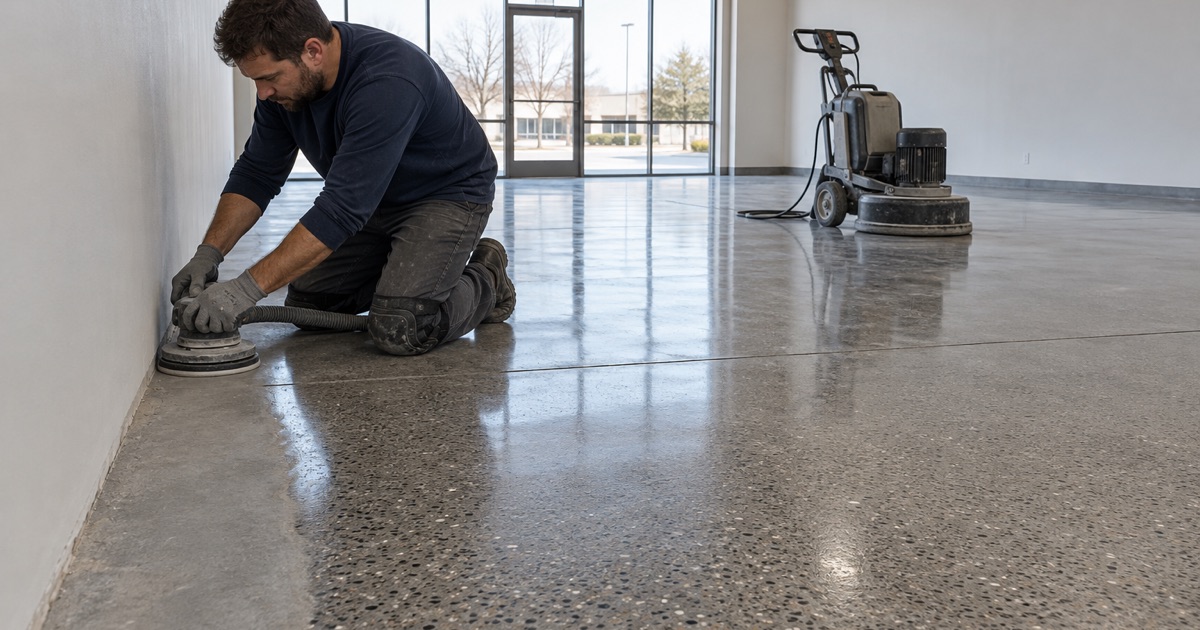
Polishing turns the slab itself into the finished surface. We grind it in stages with diamond tooling, harden it with a lithium silicate densifier and refine it to the sheen you choose, with no coating to peel, scratch through or recoat.
The proposal spells out the level of aggregate exposure, the final sheen and any guard or stain we apply. That way the finished floor can be checked against what we agreed to, pass by pass.
Polished Concrete for Homes
Polished Basement Floors
Most houses in Mount Prospect sit over a full or partial basement, and many of those slabs were poured in the 1950s through the 1970s. Polishing a basement slab gives a durable, easy-to-clean floor that suits a family room, gym or workshop.
We test the slab for moisture first, because a basement with water coming up through it can show dark patches or efflorescence through a polish. A floor that keeps getting wet is a drainage job before it is a flooring job.
What an Older Slab Will Show
A mid-century slab carries patches, trowel marks, old tack strip holes and adhesive from past carpet or tile. Polishing does not hide those marks; it frames them, which some owners love and others do not.
Before we quote, we grind a small test area so you can see the color, the stone and the history in your own floor. If the result is not what you want, we will point you toward a coating instead.
Grinding Off Old Adhesive and Paint
Carpet glue, tile mastic and old paint have to come off before the polishing passes start. We remove them with coarse diamond tooling or shot blasting, collecting the dust at the machine.
Some old black mastics deserve testing before they are ground. If an adhesive looks suspect, we stop and recommend testing rather than guessing.
Polished Concrete for Commercial Spaces
Showrooms and Retail Floors
Polished concrete gives a showroom or shop floor a clean, reflective look that holds up to foot traffic without a film that scuffs. The sheen can be set from satin to high gloss to suit the space and the lighting. Because there is no coating to wear through, traffic lanes age far more evenly than they do on a coated floor.
A polished floor also bounces light back into the room, which can make a showroom with few windows feel brighter. We pick the sheen with the lighting in mind, since a very high gloss can show glare under some fixtures.
Warehouse and Flex-Space Floors
Business parks such as Kensington Business Center are full of flex buildings with large slabs that see forklifts and pallet jacks. A densified, polished slab resists dusting and stands up to wheel traffic, and there is no film for a forklift tire to tear. We work around racking and operations by sectioning the floor, and we schedule passes for nights and weekends when the building has to keep running.
Where a Coating Fits Better
Polished concrete is not the answer for every commercial floor. Areas that see regular chemical spills, hot washdowns or heavy oil are better served by an epoxy or urethane cement system that seals the surface. We will tell you plainly when a coating is the right call for part or all of the floor.
Many buildings end up with both. A showroom or office can be polished while the shop, wash bay or break room behind it gets a seamless coating, and we plan the transition between the two so the edge is clean and level.
Polishing Options and Finishes
Cream, Salt and Pepper or Full Aggregate
How deep we grind decides how much of the stone inside the concrete shows. A light grind keeps the cream finish at the surface, a moderate grind exposes fine aggregate in a salt and pepper look, and a deep grind reveals larger stones across the floor. Deeper grinds take more passes and cost more, and on an older slab the stone can vary from one pour to the next.
Densifier and Guard
A lithium silicate densifier reacts with the concrete to harden the surface and reduce dusting. A penetrating guard then slows staining and helps the polish keep its shine between cleanings.
Neither is a coating, so they do not peel. They do need the surface kept clean, because grit is what dulls a polished floor.
Dyes, Borders and Saw-Cut Lines
Concrete dyes can tint a polished floor in solid color or in patterns, and saw-cut lines and borders can define walkways or zones. Those details are laid out with you before any cuts are made. On an older slab, dye can take unevenly where patches differ from the original pour, so we test it on your floor first.
How a Polishing Job Runs
Survey and Test Area
We walk the slab, map cracks and patches, test for moisture and grind a test area. You see the likely result before the full job is scheduled.
The survey also tells us how hard the concrete is, which decides the diamond tooling and how many passes the floor will take. A soft or dusty slab and a hard, dense one polish very differently, and the schedule in the proposal reflects which one you have.
Grinding and Repair Passes
Coarse passes flatten the surface and remove coatings, then cracks and pits are filled. The densifier goes on between grinding and honing so it can penetrate open concrete.
Crack filler in a polished floor stays visible as a line, because it is a different material from the slab around it. We talk through whether you want those lines filled to match, filled in a contrasting tone or left as a feature of an older floor.
Honing, Polishing and Final Walk
Finer passes build the sheen to the level in the proposal, and the guard is applied at the end. We walk the floor with you and go over cleaning and care before we leave.
An auto scrubber or a microfiber mop with a neutral cleaner is all the daily care a polished floor needs. We leave you with written care notes so the shine you see on the last day lasts.
Cost and Planning
What Changes the Price
The square footage, the hardness of the slab, the level of aggregate exposure and the amount of old material to remove are the main drivers. A cream finish takes fewer passes than full aggregate, and a floor buried under carpet glue takes extra coarse grinding before polishing even starts.
Dyes, borders, saw-cut lines and crack repair add their own lines to the quote. Every one of them is itemized in the proposal so you can see where the money goes.
Polishing an Occupied Building
In a home, polishing usually means emptying the room and keeping it clear for a few days. In a business, we section the floor so the rest of the building keeps working, and we schedule the loud, dusty passes for nights or weekends when people are not at their desks. Vacuums run at every grinder, and we never rinse slurry toward a floor drain or the street, so cleanup happens as we go rather than at the end.
- 20+ Years on Concrete
- Moisture Tested Before Pricing
- Written Itemized Proposals