
Mount Prospect Epoxy Flooring handles concrete floor repair in Mount Prospect, IL, serving surrounding cities including Prospect Heights, Wood Dale, Bensenville, Schiller Park and Deerfield. In more than 20 years on concrete, we have learned that the most valuable part of a repair is the honest assessment before it: which cracks can be filled, which ones are still moving, and when a slab should be replaced rather than patched and coated.
We map every crack, spall and failed patch before we quote. The proposal lists each repair by type and location, so you know what is being fixed and why.
Most slabs we see here are old. Around 70 percent of local housing units were built between 1950 and 1979, and decades of settling, patching and road salt show up in the floors of their garages and basements.
Cracks in Concrete Floors
Shrinkage and Hairline Cracks
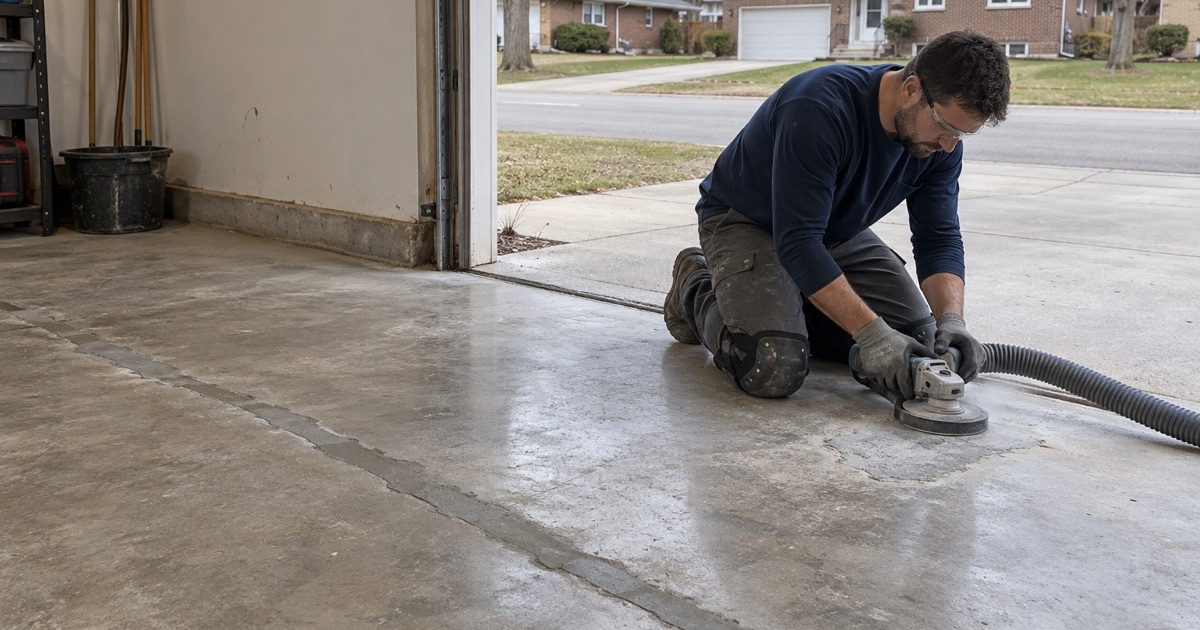
Almost every slab develops fine shrinkage cracks as it cures and ages. They rarely affect the strength of the floor, but they collect dirt and can telegraph through a thin coating. We chase them open with a grinder, fill them with a rigid repair material and grind the fill flush, so a new floor lays down smooth over them.
Settled and Displaced Cracks
When the ground under a slab settles, cracks open wider and one side can sit lower than the other. That height difference becomes a trip edge and a weak point in any coating.
We grind the edges down where the difference is small and rebuild the low side with a repair mortar. Large displacement points to a slab that may need more than surface repair.
Moving Cracks
Some cracks keep opening and closing with the seasons or with loads. A rigid filler in a moving crack will crack again, and so will the coating over it.
We treat those cracks as joints, using a flexible filler and carrying the joint through the coating. If movement is severe, we tell you the slab has a structural problem a floor cannot fix.
Spalls, Pitting and Scaling
Salt Scaling at the Garage Door
Calcium chloride brine and rock salt ride into the garage on tires and soak into the slab where the car parks and in front of the door. Freeze-thaw cycles then break up the surface, leaving rough, flaking patches. We grind off the loose layer, rebuild the low areas and level them so a coating can go down over a sound, even surface.
Spalled Edges and Joints
Spalls are chips and broken pieces along cracks, joints and slab edges, often from impact or from water freezing in the joint. Left alone, they grow every winter. We cut back to sound concrete, clean the area and fill it with a repair mortar that bonds to the slab and grinds flush.
Pitted and Worn Surfaces
Old floors often have a pitted, worn surface where the cement paste has eroded and left the sand and stone exposed. A coating laid directly over it uses extra material and can show every pit. We fill the surface with a skim coat or a filled epoxy base before the main system goes down.
Repair Before Coating
Why Repairs Come First
A coating cannot hold a broken floor together. Cracks, spalls and hollow patches under a new system become the first places it fails. That is why repair is mapped and priced before we quote any coating, rather than discovered on the day of the install.
Old Patches and Failed Repairs
Many slabs carry old patches that have loosened, cracked around their edges or sound hollow when tapped. A coating over a loose patch lifts with it. We sound the floor, remove failed patches and rebuild them so the whole slab is bonded and sound.
Moisture and Repairs
Some repair materials and coatings are sensitive to moisture coming up through the slab. A moisture test is part of every coating scope, so the repair products match the floor’s conditions. Where moisture is high, we may specify a mitigation primer over the repaired slab before the coating goes on.
When a Slab Needs More Than Repair
Heaved and Broken Slabs
A slab broken into sections, heaving with frost or sinking at one end is beyond what surface repair can fix. Coating it would only cover the problem until it reappeared. We say so plainly and recommend a slab contractor rather than selling a floor that will fail.
Village Standards for Replacement
Mount Prospect’s garage standard calls for a minimum 5-inch slab over at least 4 inches of crushed stone, and the village’s flatwork supplement says its requirements apply to replacement and repair. A replaced garage slab has to meet those standards. We ask the Building Division about permits rather than assuming either answer, and we coat the new slab once it has cured and tested dry enough.
Repair Materials and Planning
Rigid Fillers and Repair Mortars
Rigid epoxy and polyurea crack fillers bond to the concrete and grind flush, which makes them right for dormant cracks under a coating. Polymer-modified repair mortars rebuild deeper spalls and broken edges. We match the material to the depth of the repair and the system that goes over it, so the patch and the coating cure and wear together.
Flexible Joint Fillers
Where a crack or joint keeps moving, a flexible or semi-rigid filler lets the slab move without tearing the floor apart. In a commercial floor, joints that carry forklift or pallet jack wheels need a filler firm enough to support the wheel edge. We choose the joint treatment by how the floor is used, not by habit.
What Moves the Price
Repair pricing follows the number and length of cracks, the size and depth of spalls, and how many old patches have to come out. A floor with a few hairline cracks costs very little to prepare, while a salt-scaled garage apron or a heavily patched basement takes real time. Each repair is listed in the proposal by type and location, so you can see where the cost comes from before the work begins.
- 20+ Years on Concrete
- Moisture Tested Before Pricing
- Written Itemized Proposals