
Mount Prospect Epoxy Flooring installs epoxy garage floors in Mount Prospect, IL, serving surrounding cities including Prospect Heights, Wood Dale, Bensenville, Schiller Park and Deerfield. With more than 20 years on concrete, we build garage floors the way the coating makers intend: a ground slab, a moisture reading, repaired cracks, a 100% solids base and a topcoat that can take a Chicago-area winter.
The floor you end up with is spelled out before we start. Your proposal names the product line, how many coats go down and the finished film thickness, so you can measure what was installed against what was quoted.
We also cover the paperwork that goes with a home job. A garage floor over the state threshold gets a written contract and the Illinois Home Repair: Know Your Consumer Rights pamphlet before any grinding begins, as the Home Repair and Remodeling Act requires.
Our Step-by-Step Epoxy Garage Floor Process
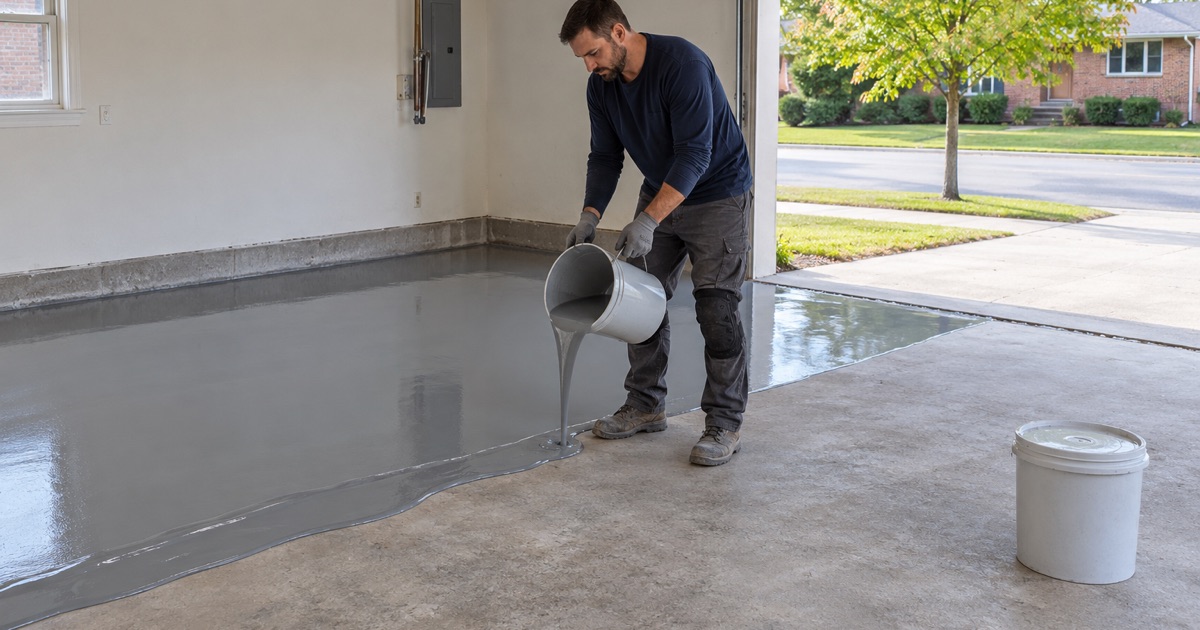
Step 1: Slab Survey and Moisture Test
We start by walking the garage floor and marking every crack, spall, oil stain and patch of old coating. A calcium chloride test or a plastic sheet test tells us how much moisture is moving through the slab, which matters here because the village garage standard puts a 5-inch slab over 4 inches of crushed stone with no vapor retarder shown.
That survey becomes the scope. If the slab needs repair or replacement before it should be coated, you hear it at this step.
Step 2: Grinding With Dust Collection
The slab is opened with a diamond grinder or a shot blaster until it reaches the concrete surface profile the base coat needs. Old sealer, paint and the weak top skin come off with it.
Dust is pulled into a vacuum at the machine, not swept or rinsed toward the floor drain or the street. Edges and corners are ground by hand so the profile reaches the walls.
Step 3: Crack and Spall Repair
Cracks are chased open and filled with a rigid repair material, and spalled areas around the door and drain are rebuilt flush. Control joints are honored so the coating does not crack where the slab is designed to move. Repairs are ground flat after they cure, so they disappear under the finished floor rather than showing as bumps.
Step 4: Base Coat and Broadcast
A 100% solids epoxy base goes down at the thickness written in the proposal. While it is wet, we broadcast vinyl flake to refusal, which means the chips cover the base completely and give the floor its color and texture.
Once the base cures, the loose flake is scraped and vacuumed off. What stays is locked into the resin.
Step 5: Topcoat and Walk-Through
A clear polyaspartic topcoat seals the flake and gives the floor its chemical and UV resistance. We match the sheen and any antislip additive to how you use the garage. Before we leave, we walk the floor with you, go over the cure schedule and explain how to keep it clean through salt season.
Garage Floor Coatings Built for Salt and Cold
Salt-Resistant Garage Systems
Calcium chloride brine and rock salt ride into the garage all winter in the wheel wells and drip off where the car parks. On bare concrete, that meltwater soaks in and works on the surface through every freeze and thaw.
A full flake broadcast under a polyaspartic topcoat keeps the brine sitting on top, where it can be pushed out the door. We choose the topcoat for its chemical resistance as much as its shine.
Coating Temperature and Dew Point
Resin cures slowly on a cold slab, and a cold slab sitting near the dew point can pull a thin film of moisture onto its surface. Coating in those conditions risks amine blush, a tacky cure and a weak bond.
We read slab temperature and the dew point spread before each coat rather than going by the date. An attached garage against a heated wall often stays workable into late fall, while a detached garage in deep winter usually has to wait for spring.
Hot Tire Pickup and Film Thickness
A warm tire rolling onto a thin coating can soften it and peel it up as the tire cools. That failure belongs mostly to thin water-based kits laid on an acid-etched slab.
Our systems are built in full coats over a ground surface. Enough film thickness and a real mechanical bond are what keep the coating on the floor when you pull in after a summer drive.
Garage Floor Finishes and Options
Vinyl Flake Blends
Flake is the most common finish for an epoxy garage floor because it hides dust, tire marks and small slab flaws. The blend sets the overall tone, from neutral gray to bold mixes, and chip size changes how busy the floor reads. We bring sample boards to the estimate so you can see each blend against your own walls and lighting.
Solid Color and Workshop Floors
A solid color floor suits a garage that doubles as a workshop, where a dropped screw needs to be found fast. A lighter color also brightens a space with one small window. Solid floors show scratches more readily than flake, so we talk through how the space is used before recommending one.
Antislip Texture and Sheen
Gloss shows off a flake blend, but it also shows footprints and can be slick under wet boots. Satin hides daily marks better, and an antislip aggregate in the topcoat adds grip where snowmelt collects. We set the texture so the floor still squeegees and mops clean.
Attached and Detached Garages
In a county assessor sample of the village, a little under two thirds of houses with a garage have an attached one, and the rest stand apart. An attached garage shares a wall with the heated house, so its slab stays warmer and its coating window is longer.
A detached garage is its own unheated building, often at the back of a long driveway. We plan its cure schedule around its own slab temperature and stage equipment so the driveway stays usable where it can.
Before Your Garage Floor Is Coated
What Moves the Price
The square footage sets the base, and the slab condition sets most of the rest. Old coating removal, the number of cracks and spalls to repair, a moisture-mitigation primer and the choice between a solid color and a full flake broadcast are the lines that change a quote the most.
We price a garage floor only after the survey and moisture test. A number given over the phone without seeing the slab cannot account for any of those lines.
Store-Bought Kits Versus a Built Floor
A kit from a home center is usually a thin water-based epoxy rolled onto an acid-etched slab. It can look fine for a season, but the etch leaves old sealer and weak paste behind, and the thin film is the one most likely to lift under hot tires.
A built floor is ground, repaired and laid in full coats of 100% solids epoxy and polyaspartic. The difference usually shows in the second winter rather than the first week.
Warranty Exclusions to Know
Coating warranties almost always exclude damage from moisture coming up through the slab, and most exclude impact damage and chemicals left standing. We go over those exclusions before you sign, so nothing about the warranty surprises you later.
Floor Drains in the Garage
The village does not allow garage floor drains unless they are connected to a triple basin interceptor. If your garage has a drain, we coat around it carefully and slope the finish so water still reaches it. We never route grinding slurry or dust into that drain, and we ask the village Building Division about any permit question rather than assuming the answer.
- 20+ Years on Concrete
- Moisture Tested Before Pricing
- Written Itemized Proposals