
Mount Prospect Epoxy Flooring coats basement floors with epoxy in Mount Prospect, IL, serving surrounding cities including Prospect Heights, Wood Dale, Bensenville, Schiller Park and Deerfield. A basement floor is the most moisture-sensitive job we do, and after more than 20 years on concrete our first question about one is never the color: it is how much water is moving through the slab.
That question matters more here than in most places. In a county assessor sample of the village, better than nine in ten houses sit over a full or partial basement, and most of those slabs were poured between the 1950s and the 1970s, long before under-slab vapor retarders were routine.
So every basement floor epoxy job starts with a moisture test that is part of the scope, not an upsell. The result goes into a written proposal that names the primer, the system, the coat count and the finished thickness.
Moisture First, Coating Second
Testing the Slab
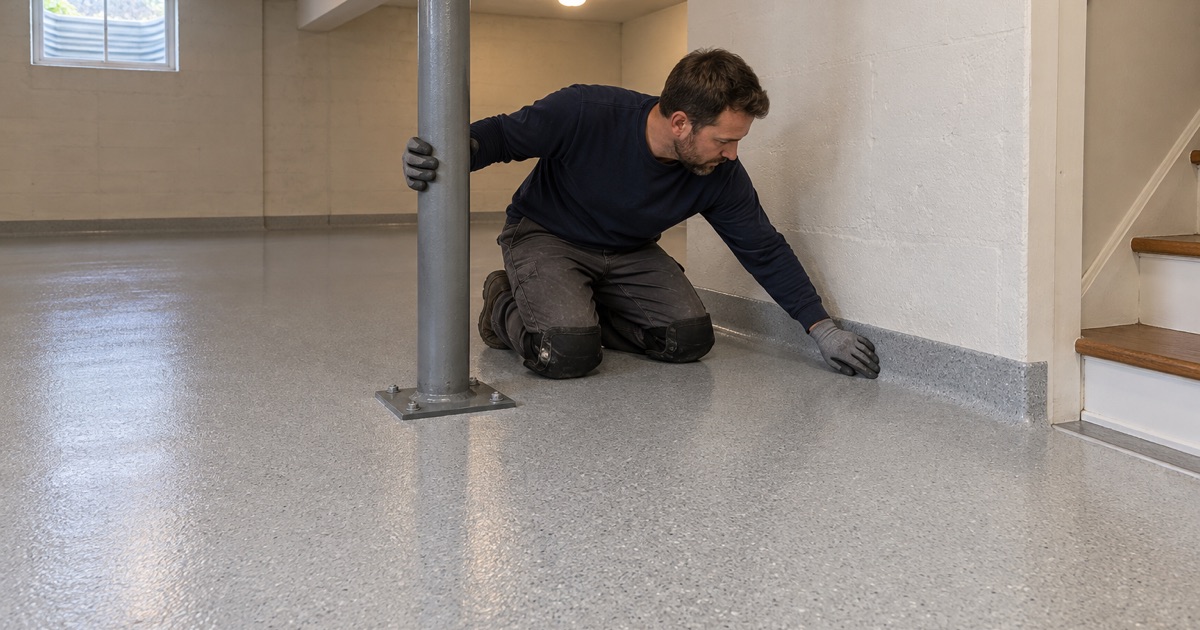
We test a basement slab with a calcium chloride moisture emission test, an in-situ relative humidity probe or a plastic sheet test, depending on the floor and the system. Each one tells us whether vapor coming up through the concrete is within what the coating maker allows.
Testing happens before the price is final. A basement floor quoted without it is a guess, and a wrong guess shows up as bubbles and peeling within a year.
Efflorescence and What It Means
A white, powdery crust on a basement floor or along the walls is usually efflorescence, the mineral salts left behind as water moves through concrete and evaporates. It means the slab is carrying moisture, even on days it looks dry.
Efflorescence is ground off before coating, and it nearly always points us toward a mitigation primer. Coating straight over it guarantees a weak bond.
Moisture-Mitigation Primers
A moisture-mitigation primer is a dense epoxy layer built to hold back vapor that would push a standard coating off the slab. We specify it when the test reading is above the topcoat’s limit but within what the primer can handle.
It adds a coat and a cost, and it is often what makes a damp basement coatable at all. When a slab reads beyond even the primer’s limit, we say so instead of selling a floor that will fail.
Hydrostatic Pressure
When groundwater pushes up against the underside of a slab, that hydrostatic pressure can force water through cracks and joints. No floor coating can resist it from the top side. If we see signs of water under pressure, such as wet cracks or water at the wall joint after rain, we recommend fixing drainage before any coating is discussed.
Water, Drains and Sewers
Coating After a Sewer Backup
A basement that has taken a sewer backup needs cleanup, disinfection and thorough drying first. Coating a slab that is still wet from a backup traps moisture and contamination under the film.
We coat only after the drying is done and a fresh moisture test confirms the floor is ready. If the cause of the backup has not been fixed, we tell you before we quote.
Combined Sewers and the Overhead Sewer Rebate
About a third of the village-owned sewer system is combined, and the village says buildings on those lines lack overhead sewers and are more prone to flooding through floor drains. Its Overhead Sewer Rebate Program reimburses single-family owners up to 50 percent of a conversion, capped at $7,500.
The village also says indirect costs such as new floor tile may not be covered. We recommend finishing the conversion first and coating the floor last, so the new floor is not torn up by the plumbing work.
Not Waterproofing
A coating is a wear surface. It will not stop water coming up a floor drain, seeping through a wall joint or pushing through a crack.
We never sell a basement coating as waterproofing or flood protection. On a basement that has taken water, the drain, the backwater valve and the drying come first.
Floor Drains, Sump Pits and Slope
The village’s basement guidance expects sump and ejector pumps, so most basements we coat have a sump pit, a floor drain or both. We coat up to and around them and keep lids and covers removable. The slope to the floor drain stays intact, and grinding dust is vacuumed at the machine rather than washed into the drain.
Systems and Finishes for Basements
Flake Floors for Family Rooms and Gyms
A vinyl flake broadcast under a clear topcoat is the most popular basement finish because it hides slab flaws and adds light texture underfoot. It works in family rooms, home gyms and play areas where a durable, cleanable floor matters. We bring sample blends so you can choose under your own basement lighting.
Solid Color for Laundry and Utility Rooms
A solid color coating suits laundry rooms, furnace rooms and storage areas where a clean, bright floor is the goal. A lighter color also makes a low-ceiling basement feel more open. We add antislip texture near washers and sinks, where water ends up on the floor.
Partial Basements and Mixed Floors
Partial basements are common in the village, which often means a coated floor runs beside a crawl space or a section on slab. Different areas can carry different moisture levels, so we test each one rather than assuming the whole floor matches. Where one area reads higher, it gets the primer and the others may not.
Safety and Honest Limits
Radon Is Licensed Work
A floor coating may cover small surface cracks, but it is not a radon system. In Illinois, radon mitigation is licensed by the Illinois Emergency Management Agency.
We never sell a basement floor as radon reduction. If radon is a concern, have a licensed mitigator test and treat it before or alongside the floor work.
Ventilation During the Job
Basements have little natural airflow, so we plan ventilation for every coat. We choose products inside the Illinois VOC limits for floor coatings, which apply to the person putting the product down, and we tell you ahead of time whether the house should be clear during application.
Planning a Basement Floor Job
What Moves the Price
A basement floor is priced from the square footage, the moisture reading, the amount of crack and spall repair, the system and the access. A narrow stair, a crowded utility room and a sump pit to detail around all add time.
A mitigation primer is the line that changes a basement quote most often. That is why we test before we price instead of adding it as a surprise once the job has started.
Getting the Basement Ready
The floor has to be cleared of furniture, boxes and anything stored on it, and the furnace and water heater areas need to be reachable. Carpet, pad, tack strip and old tile come out before we arrive, or we can quote their removal and the adhesive grinding that follows. We protect stairs and the route to the door so grinding equipment does not mark finished rooms on the way down.
Contracts, Warranty and Village Rules
A basement job over the state threshold gets a written contract and the Illinois consumer-rights pamphlet for home repair before any grinding starts. We explain what the coating warranty excludes, beginning with moisture, before you sign.
Illinois has no state flooring license, so we check the village’s own registration, bond and insurance rules before booking, and we ask the Building Division whether the work needs a permit.
- 20+ Years on Concrete
- Moisture Tested Before Pricing
- Written Itemized Proposals